
The Loviis Wheel
Shed light on your relationship
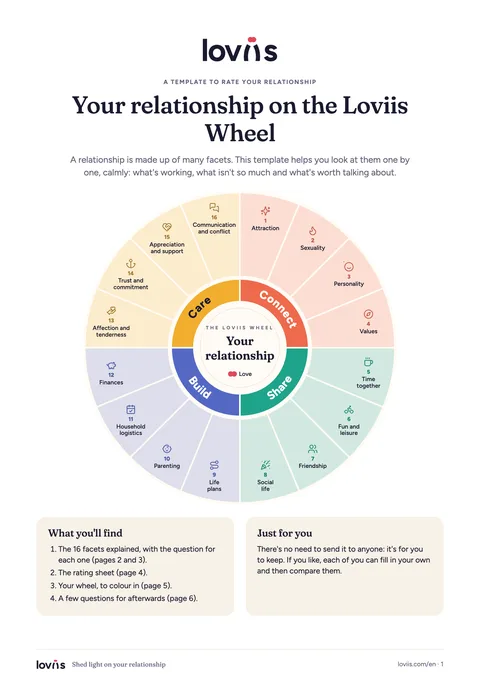
Every relationship rests on four dimensions: Connect, Share, Build and Care. Explore them one by one and discover what's working, what needs a little more attention and what's worth talking about together.
Total confidentiality: your answers are yours alone. How we protect them
Four dimensions to understand your relationship
Each dimension brings together four facets of life as a couple. Tap any part of the wheel (a facet, a dimension or the centre) to see what it means and the question used to rate it.
The four dimensions and the underlying question behind each one. Love sits at the centre, on its own. Tap any part of the wheel, or one of these dimensions, to see what it means.
Three starting points
It's dynamic
The wheel is a snapshot of the moment. The facets, and how much each one matters to you, change over time.
They don't all weigh the same
Everyone gives more weight to some facets than to others. That's why you can mark when one matters to you especially much or especially little.
A relationship isn't an average
One important gap can weigh more than several well-rated facets. That's why there's no total score.
The four dimensions, up close
Open any facet to read what it covers and the question used to rate it. There's no need to read them all at once: start with the dimension that speaks to you most.
Connect
What attracts me to my partner and makes me feel we fit together?
1AttractionLooks, presence, style, intelligence: what sparks my interest and desire.
The attraction I feel towards my partner: their physical appearance, presence, style, intelligence and other qualities that spark my interest and my desire to be close to them.
Question, from 0 to 10: How satisfied am I with the attraction I feel towards my partner?
2SexualityDesire, frequency, initiative, physical intimacy and mutual satisfaction.
Our sex life: desire, frequency, initiative, preferences, physical intimacy and mutual satisfaction. It's not just about how much sex we have, but about how we experience our sexuality and whether our needs are being met well enough.
Question, from 0 to 10: How satisfied am I with our sex life?
3PersonalityTheir personality, character, humour and lifestyle, and how it fits with mine.
Who my partner is and how they behave: personality, character, sense of humour, attitude to life, habits, energy and lifestyle. It includes how much I like the way they are and how well it fits with mine.
Question, from 0 to 10: How satisfied am I with my partner's personality and how it fits with mine?
4ValuesCompatible core principles: honesty, respect, beliefs…
The principles and values that guide our lives, such as honesty, respect, tolerance, integrity and responsibility, as well as religious or spiritual beliefs when they matter. We don't need to agree on everything, but we do need to feel that our core values are compatible.
Question, from 0 to 10: How satisfied am I with my partner's values and how compatible they are with mine?
Share
What do we enjoy living and sharing together?
5Time togetherTime together, feeling accompanied and each person's own space.
Enjoying spending time together, keeping each other company and sharing everyday moments, even when we're not doing anything special. It includes feeling accompanied and finding a good balance between shared time and the personal time each of us needs for our own interests and independence.
Question, from 0 to 10: How satisfied am I with the time we spend together, the company we keep each other and the personal space we each have?
6Fun and leisureHobbies, leisure and activities we enjoy doing together.
Sharing hobbies and activities we especially like and enjoy doing together: sport, travel, dancing, culture, nature or other leisure experiences. It's not about doing everything together.
Question, from 0 to 10: How satisfied am I with the leisure activities and hobbies we share?
7FriendshipCloseness, humour, conversations and wanting to tell each other things.
Feeling that my partner is someone I enjoy talking with, laughing with and sharing thoughts, experiences and worries with. It includes closeness, humour, everyday or deep conversations and wanting to tell each other what's going on.
Question, from 0 to 10: How satisfied am I with the friendship and closeness we have as a couple?
8Social lifeFriends, families and how we get on with each other's family.
How we share and manage our social life: friendships, relationships with our respective families, and get-togethers and activities with other people. It includes how we get on with each other's family and how we respect our different social needs.
Question, from 0 to 10: How satisfied am I with our social life and how we relate to family and friends?
Build
What life are we building together?
9Life plansA compatible vision of the future: where to live, children, careers, lifestyle.
Sharing a compatible vision of the future: where to live (home, city or country), buying a home or investing, having children, starting a business, developing our careers, when to retire and the lifestyle we want. It includes how individual plans fit with shared ones.
Question, from 0 to 10: How satisfied am I with our life plans and how compatible our goals and hopes for the future are?
10ParentingRaising and educating the children, working as a team.
How we share raising, educating and caring for our children: approaches to parenting, passing on values, involvement, responsibilities and decisions. It includes feeling that we work as a team. If it doesn't apply to your situation, mark it as “Not applicable”.
Question, from 0 to 10: How satisfied am I with the way we share raising and educating our children?
11Household logisticsChores, organisation, mental load and a split that feels fair.
How we organise and share household chores, daily responsibilities, planning and mental load: shopping, cleaning, meals, home maintenance, paperwork and family organisation. It doesn't require a 50/50 split, but one that feels fair and works.
Question, from 0 to 10: How satisfied am I with how we organise our daily life and share responsibilities?
12FinancesIncome, spending, savings and how we decide about money together.
How we organise our finances: income, spending, savings, investments, contributions and financial decisions. It includes transparency, agreements and financial independence; there's no single right formula, only the one you both feel is fair enough.
Question, from 0 to 10: How satisfied am I with how we organise our finances and make decisions about money?
Care
How do we treat each other, support each other and make our relationship work?
13Affection and tendernessHugs, caresses, kind words and small gestures of affection.
Physical and emotional expressions of affection that aren't necessarily sexual: hugs, caresses, affectionate kisses, holding hands, loving words and small gestures. It includes giving and receiving affection in a way that feels good.
Question, from 0 to 10: How satisfied am I with the affection and tenderness we share in our relationship?
14Trust and commitmentHonesty, loyalty, keeping agreements and wanting to stay together.
Trusting my partner's honesty, loyalty and reliability, and that they keep our agreements. It includes mutual commitment: wanting to keep the relationship going, feeling that the other person wants to as well, and that we're both willing to put effort into it.
Question, from 0 to 10: How satisfied am I with the trust and commitment we have in our relationship?
15Appreciation and supportFeeling valued, recognised and supported, especially when things are hard.
Feeling valued, recognised and appreciated by my partner for who I am and what I do. It includes being able to count on their emotional and practical support when I need it, especially in difficult moments. It's different from receiving affection.
Question, from 0 to 10: How satisfied am I with the appreciation, recognition and support I get from my partner?
16Communication and conflictExpressing ourselves, listening, disagreeing respectfully and making up.
Our ability to express thoughts, feelings and needs, to listen to each other and to understand our differences. It includes handling disagreements respectfully, making up after an argument and finding solutions to the conflicts in our relationship.
Question, from 0 to 10: How satisfied am I with the way we communicate and handle conflict as a couple?
Love, at the centre
What you feel for your partner isn't one more facet, nor the average of the sixteen: it's something separate. You can love your partner deeply and be unhappy with some facets, or the other way round: be content in many of them and no longer feel love. That's why it's rated separately, with a single question: how much do you feel you love your partner?
What lies outside the wheel
Some things keep a couple together but say nothing about how well they're doing: children, shared finances or a shared home, family or social pressure, fear of being alone or a lack of alternatives. It's worth keeping them in mind, without mistaking them for the quality of the relationship.
Rate your relationship
We invite you to go through the four dimensions facet by facet and score how you feel about each one. You can do it in three ways, and you decide how much you share. It takes about fifteen minutes, and there are no right or wrong answers.
- Think about your relationship as it is todayNot as it was at the beginning, nor as you'd like it to be. Just today.
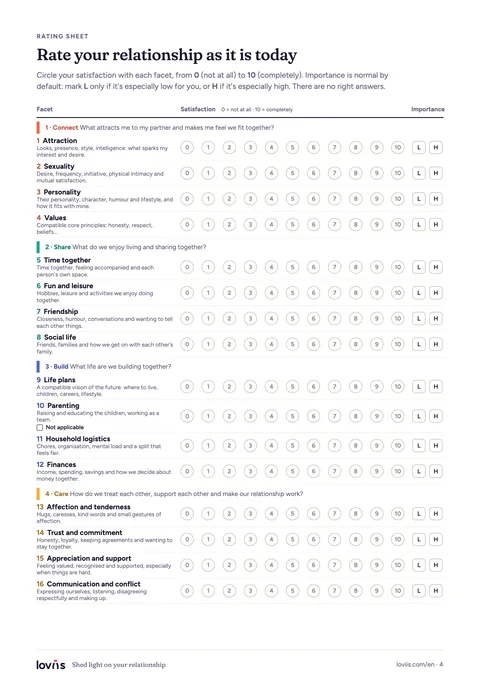
- Rate each facet from 0 to 100 means not at all satisfied and 10, completely. If a facet doesn't apply to your situation, such as Parenting, mark it as “Not applicable”.
- Mark the importance only if it stands outBy default, every facet has normal importance. Mark it only when a facet matters to you especially much or especially little.
- Rate love separatelyWith a single question: How much do you feel you love your partner?
- If you like, compareEach of you can do it separately and then put your two wheels side by side. It's a good starting point for a conversation.
Why is there no total score? On purpose. What matters is to look at each facet separately, and at each dimension's average only as a reference: a very important facet with low satisfaction deserves attention even if the average is high.
Three ways to do it
Confidentiality is key for us. Choose the way you feel most comfortable with.
Explore on the website
Go through the four dimensions and their facets here and rate them on your own, in your head or in a notebook. We don't store anything.
See the facets →On paper, at home
Download the PDF template and fill it in by hand. We only ask for your email for the download: your answers never leave your home.
Download the template →Online, with a personal report
We store your answers only to prepare your report, with a private link that only you have. We don't look at them or share them with anyone, including your partner. We'd only access them if you asked us to, for example to prepare a personal session.
Take the test →
Our commitment to confidentiality
Your data is private and confidential: we don't access it or look at it unless you ask us to. We have total respect for your confidentiality and strictly comply with data protection law (GDPR). You can ask us to delete it whenever you want. If you'd like to know more, it's all explained in our privacy policy.
Online test · Free · About 15 minutes
Do it online and get your personal report
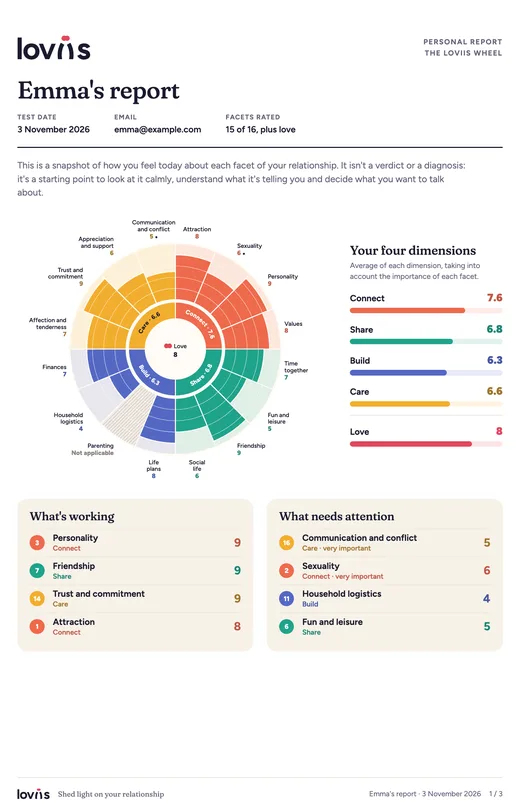
Answer right here, on your phone or computer. When you finish, you'll see your wheel straight away and get a report written for you, based on your answers, which you can save as a PDF.
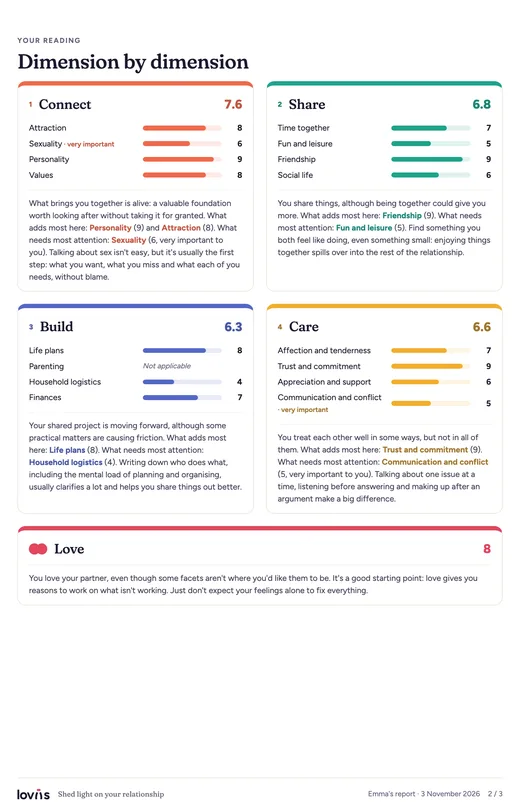
- Your Loviis Wheel. Your answers turned into a picture of your relationship, at a glance.
- What's working and what needs attention. Taking into account what matters most to you, not just the scores.
- A reflection for each dimension. With practical advice for the facets that need it most.
- Questions to talk about with your partner. To turn the result into a good conversation.
Your answers are private: no one else sees them, not even your partner.
After rating
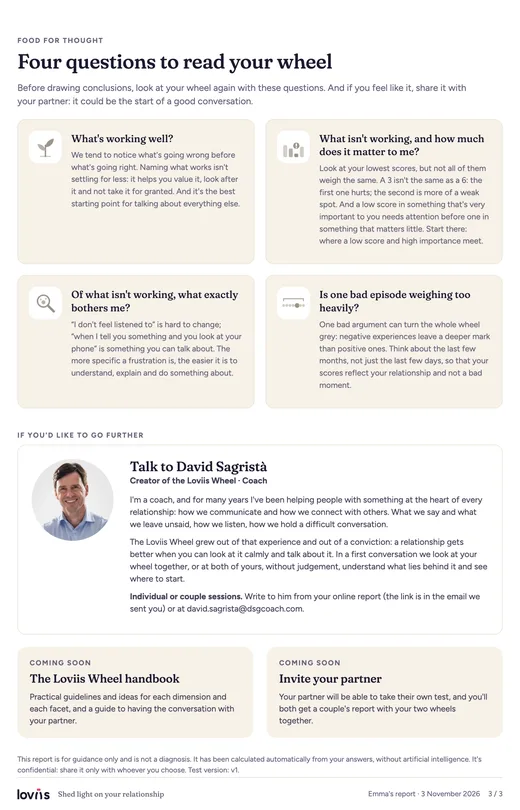
Four questions to read your wheel
Your wheel isn't a verdict: it's a starting point. Before drawing conclusions, look at it calmly and ask yourself these questions. They'll help you recognise what works, pin down what doesn't and judge fairly.
What's working well?
We tend to notice what's going wrong before what's going right. Naming what works isn't settling for less: it helps you value it, look after it and not take it for granted. And it's the best starting point for talking about everything else.
What isn't working, and how much does it matter to me?
Look at your lowest scores, but not all of them weigh the same. A 3 isn't the same as a 6: the first one hurts; the second is more of a weak spot. And a low score in something that's very important to you needs attention before one in something that matters little. Start there: where a low score and high importance meet.
Of what isn't working, what exactly bothers me?
“I don't feel listened to” is hard to change; “when I tell you something and you look at your phone” is something you can talk about. The more specific a frustration is, the easier it is to understand, explain and do something about.
Is one bad episode weighing too heavily?
One bad argument can turn the whole wheel grey: negative experiences leave a deeper mark than positive ones. Think about the last few months, not just the last few days, so that your scores reflect your relationship and not a bad moment.
Free · Printable PDF
Download the Loviis Wheel template
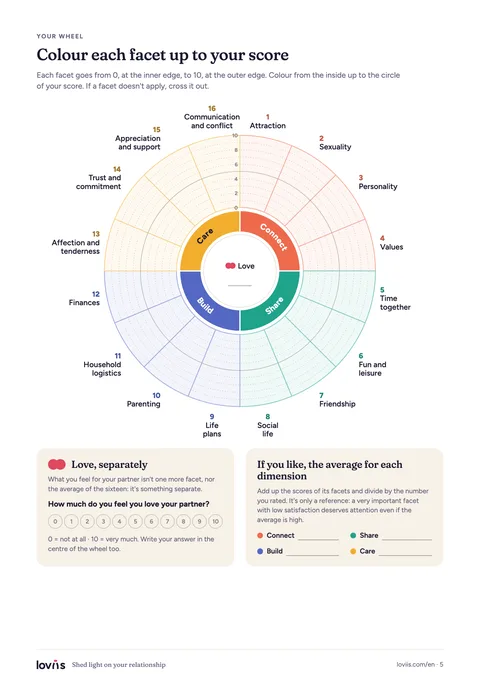
Everything you need to rate your relationship calmly, on paper. Do it on your own or as a couple: one each, and then compare them.
- The 16 facets, explained. What each one covers and the exact question to rate it.
- Your rating sheet. Score each facet from 0 to 10 and mark what matters most to you.
- Your wheel to colour in. Your answers turned into a picture of your relationship at a glance.
- Questions for afterwards. To read your wheel calmly and prepare the conversation with your partner.
Leave us your email and the download will start straight away.
What research says
A solid foundation
The Loviis Wheel isn't improvised. It draws on what decades of research on couples have shown, and each dimension connects with the ideas of leading authors on relationship satisfaction. Here are some of them, and where you'll find them on the wheel.
John Gottman
More than forty years observing real couples
A solid relationship rests on friendship, on how conflict is handled and on building shared dreams and meaning.
On the wheelFriendshipCommunication and conflictLife plans
Robert Sternberg
Triangular theory of love (1986)
Love combines three ingredients: intimacy, passion and commitment. Each couple experiences them in a different mix.
On the wheelLoveAttractionSexualityTrust and commitment
Caryl Rusbult
Investment model (1980)
Commitment doesn't depend only on satisfaction, but also on what has been invested and on the alternatives. That's why a couple can stay together without being well.
On the wheelTrust and commitmentFinancesParenting
Harry Reis
Perceived responsiveness
Feeling understood, valued and cared for by your partner is one of the firmest pillars of a satisfying relationship.
On the wheelAppreciation and supportAffection and tendernessTime together
Attachment theory
John Bowlby; Cindy Hazan and Phillip Shaver (1987)
As adults, we also look for a secure base in our partner: someone who is there for us, whom we can trust and turn to.
On the wheelTrust and commitmentAppreciation and supportAffection and tenderness
Samantha Joel and colleagues
43 studies and more than 11,000 couples (2020)
What best predicts the quality of a relationship is how the relationship itself is experienced: feeling your partner's commitment and appreciation, sexual satisfaction and the level of conflict.
On the wheelAppreciation and supportSexualityCommunication and conflict
A framework for reflection, not a diagnosis. The Loviis Wheel is an educational model, not a validated psychological test: it doesn't predict how long a relationship will last or tell you what to do. It helps you see more clearly and talk.